

Uncategorized
High THC vs. High-CBD Strains
Aug
High THC vs High CBD Cannabis Strains: What’s the Difference?
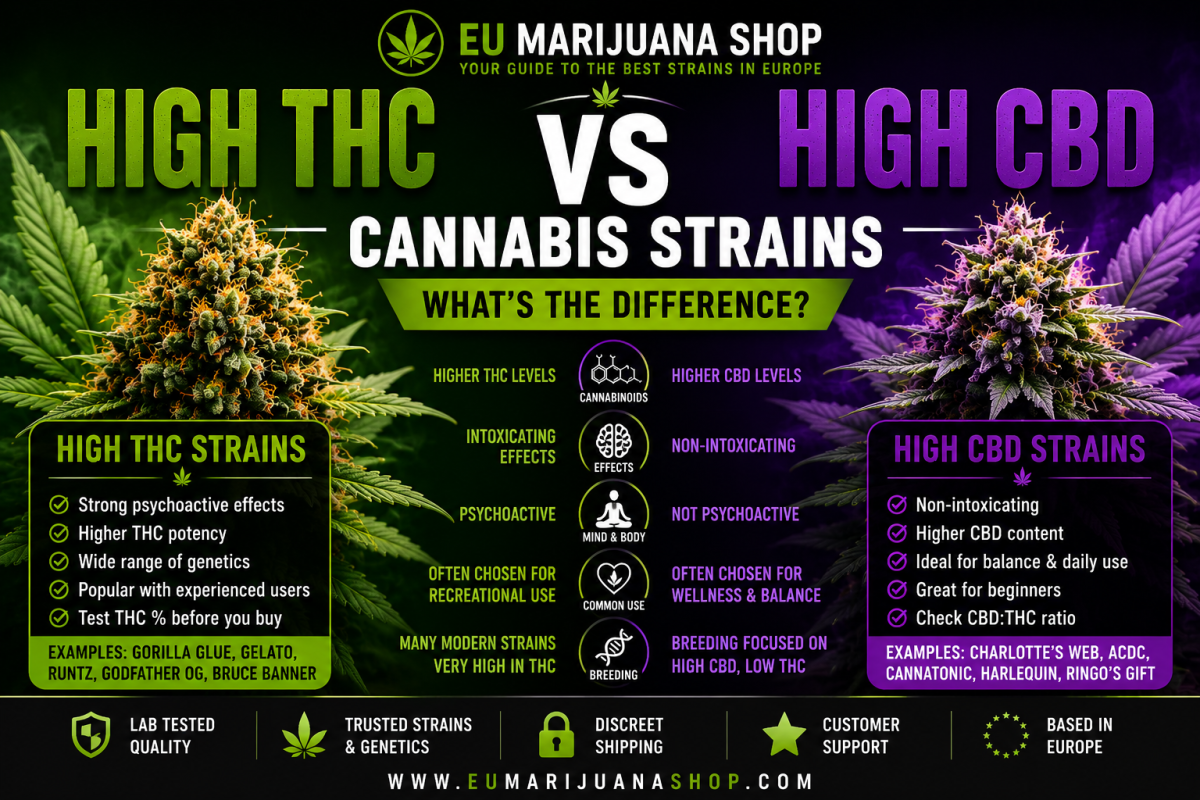
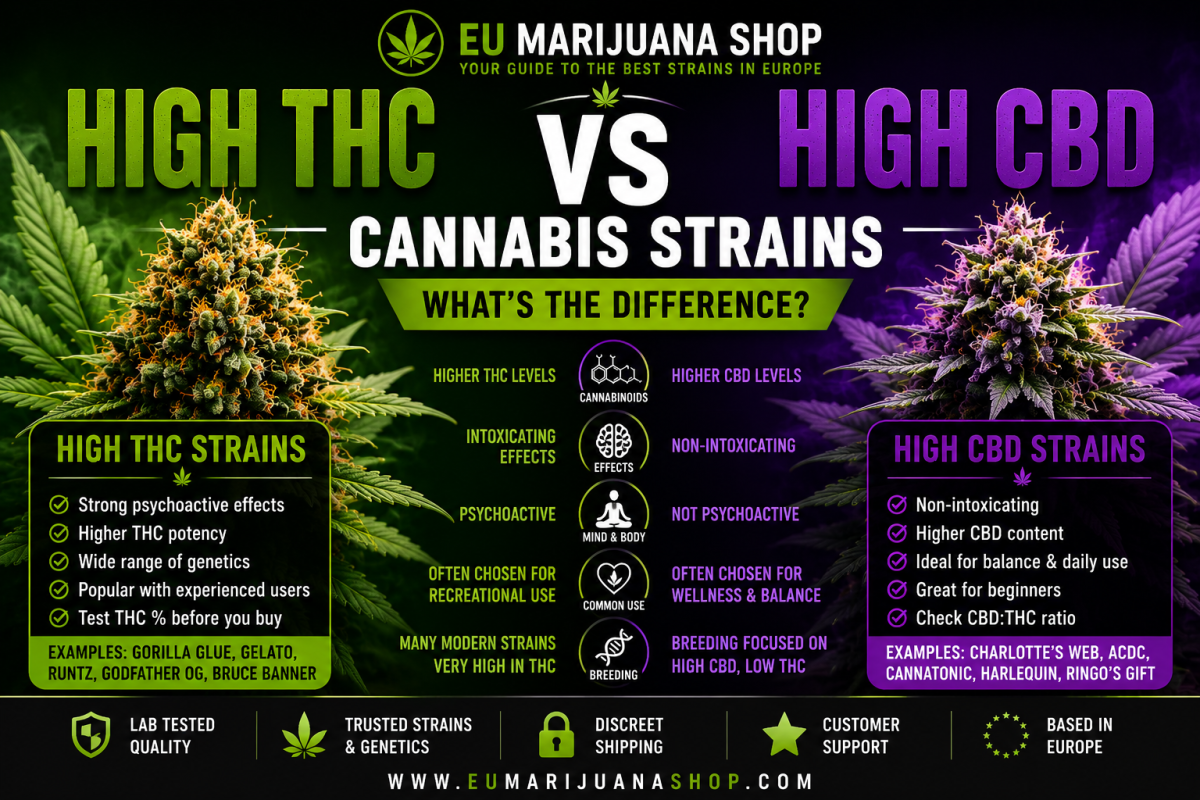
Understanding high THC vs high CBD strains is an important part of comparing cannabis varieties. High-THC and high-CBD cannabis can differ in potency, intoxicating effects, cannabinoid balance, genetics, and other key characteristics. Therefore, looking beyond the strain name and comparing the actual THC and CBD levels can provide a clearer picture of how different cannabis strains vary.
THC and CBD are two of the best-known compounds found in cannabis. However, they do not have identical properties.
THC is mainly known for producing cannabis’s intoxicating effects. CBD, on the other hand, does not produce the same type of intoxication.
As a result, two cannabis strains can have very different cannabinoid profiles even if their plants look similar.
In addition, modern cannabis breeding has created varieties with many different THC-to-CBD ratios. Some strains contain mainly THC. Others are CBD-dominant. Meanwhile, some contain a more balanced combination of both cannabinoids.
This guide explains these differences and shows why cannabinoid content can provide more useful information than simply choosing between Indica, Sativa, and Hybrid labels.
For our complete overview of cannabis genetics, visit the [Best Cannabis Strains in Europe] hub. You can also compare this guide with our [Strongest Cannabis Strains in Europe], [Best Indica Strains in Europe], [Best Sativa Strains in Europe], and [Best Hybrid Cannabis Strains in Europe] articles.
Important: Cannabis laws vary across Europe. THC-containing products may be restricted or prohibited depending on the country. Therefore, always check the laws that apply in your location.
What Is THC?
THC, short for delta-9-tetrahydrocannabinol, is one of the main cannabinoids found in cannabis.
Most importantly, THC is intoxicating.
In other words, it is largely responsible for the “high” associated with cannabis.
However, the amount of THC can vary greatly between cannabis strains and products.
For example, some cannabis flower may contain relatively low THC levels. In contrast, modern high-potency varieties can contain much higher concentrations.
Several factors can affect the final THC level, including:
- Genetics
- Growing conditions
- Plant phenotype
- Harvest time
- Drying and curing
- Storage
- Product type
- Lab testing
Therefore, a strain name alone does not guarantee a specific THC percentage.
Our [Strongest Cannabis Strains in Europe] guide explains cannabis potency in greater detail.
What Is CBD?
CBD, short for cannabidiol, is another major cannabinoid found in cannabis.
Unlike THC, CBD does not cause the same intoxicating high.
As a result, CBD-rich cannabis has a very different cannabinoid profile from high-THC cannabis.
Some cannabis varieties have been selectively bred to contain higher CBD levels. At the same time, breeders may select plants with lower THC concentrations.
Therefore, CBD-dominant strains can have very different THC-to-CBD ratios.
However, it is important to remember that CBD content can still vary between individual products.
For this reason, lab information is more useful than relying only on a strain’s name.
High THC vs High CBD Strains: Quick Comparison
| Feature | High-THC Strains | High-CBD Strains |
|---|---|---|
| Main cannabinoid | THC | CBD |
| Intoxicating | Yes | CBD itself is not intoxicating |
| Typical breeding focus | Higher THC | Higher CBD |
| Potency discussions | Usually based on THC level | Usually based on CBD level |
| Common product information | THC percentage | CBD and THC percentages |
| Best comparison method | Lab cannabinoid profile | Lab cannabinoid profile |
However, these are broad categories.
In reality, cannabis cannabinoid profiles exist on a spectrum rather than fitting into only two groups.
What Are High-THC Cannabis Strains?
High-THC strains are cannabis varieties that have been selected or bred for relatively high THC production.
Over time, selective breeding has helped create genetics capable of producing substantial THC levels under suitable growing conditions.
As a result, many modern cannabis strains have developed reputations for potency.
Examples commonly discussed in connection with high THC include:
- Godfather OG
- Bruce Banner
- Gorilla Glue (GG4)
- Girl Scout Cookies (GSC)
- Wedding Cake
- Gelato
- Runtz
- GMO
However, these names should not be treated as guaranteed THC specifications.
For example, one Gelato product may test differently from another Gelato product.
Therefore, current product-specific testing is more useful when comparing potency.
See our [Strongest Cannabis Strains in Europe] guide for a deeper look at high-potency genetics.
What Are High-CBD Cannabis Strains?
High-CBD cannabis strains contain higher levels of cannabidiol compared with wide conventional high-THC varieties.
Some have been bred specifically to produce CBD while keeping THC relatively low.
Others can contain meaningful amounts of both cannabinoids.
Well-known CBD-rich or CBD-associated genetics include varieties such as:
- Charlotte’s Web
- ACDC
- Cannatonic
- Harlequin
- Sour Tsunami
- Ringo’s Gift
However, cannabinoid levels can differ between breeders and individual batches.
Therefore, the strain name should not replace actual lab information.
What Are Balanced THC and CBD Strains?
Cannabis does not have to be strongly THC-dominant or CBD-dominant.
Instead, some strains can produce a more balanced cannabinoid profile.
These varieties may contain meaningful levels of both THC and CBD.
For example, a product could have a THC-to-CBD ratio closer to 1:1.
However, the exact ratio varies.
A strain described as balanced does not mean every plant or product will contain exactly equal amounts of THC and CBD.
Therefore, actual testing remains important.
Balanced genetics are useful examples of why cannabis cannot always be divided into simple “strong THC” and “CBD” categories.
THC vs CBD: Which One Causes a High?
THC is the cannabinoid mainly responsible for cannabis intoxication.
CBD does not produce the same type of high.
Therefore, a high-THC strain and a high-CBD strain can differ greatly in their intoxicating potential.
However, the experience of cannabis is not determined by one number alone.
Other factors can include:
- Amount consumed
- Product format
- Individual sensitivity
- Previous cannabis exposure
- Other cannabinoids
- Terpenes
As a result, THC percentage is useful information, but it cannot predict every person’s experience.
Our [Cannabis Strains and Their Effects Explained] article explores this topic further.
Does More THC Mean a Stronger Strain?
Generally, a higher THC concentration means that the product contains more THC by weight.
Therefore, THC percentage is useful when comparing cannabis potency.
However, higher THC does not automatically mean better cannabis.
This distinction is important.
For example, cannabis quality can also depend on:
- Genetics
- Freshness
- Terpene profile
- Growing quality
- Drying
- Curing
- Storage
- Cannabinoid balance
As a result, a strain with the highest THC number is not automatically the highest-quality option.
This is one of the main points covered in our [Strongest Cannabis Strains in Europe] guide.
Does More CBD Mean Better Cannabis?
No.
Just as higher THC does not automatically mean better cannabis, higher CBD is not a universal quality score.
Instead, CBD percentage simply describes one part of the cannabinoid profile.
For example, one CBD-rich variety might contain considerably more CBD than another.
However, the second strain could have a different terpene profile or cannabinoid balance.
Therefore, the complete product profile matters more than one number.
THC-to-CBD Ratios Explained
One useful way to compare cannabis is through the THC-to-CBD ratio.
For example, cannabis can be described broadly as:
THC-Dominant
These products contain much more THC than CBD.
Many modern recreational cannabis strains fall into this broad category.
CBD-Dominant
These products contain more CBD and relatively little THC.
Balanced
These products contain meaningful levels of both THC and CBD.
A ratio close to 1:1 is often described as balanced.
However, ratios can take many forms.
For example, a product could be:
- 1:1 THC to CBD
- 2:1 THC to CBD
- 1:2 THC to CBD
- 10:1 CBD to THC
Therefore, looking at both cannabinoid percentages provides more information than looking at THC alone.
High-THC Indica Strains
Some Indica and Indica-dominant strains have developed reputations for relatively high THC levels.
Examples can include:
- Godfather OG
- GMO
- Wedding Cake
- Grease Monkey
However, the Indica label itself does not mean high THC.
In fact, two Indica products can have very different cannabinoid profiles.
Therefore, consumers should compare actual THC and CBD information rather than relying only on the Indica classification.
Explore more genetics in our [Best Indica Strains in Europe] guide.
High-THC Sativa Strains
Sativa and Sativa-dominant cannabis can also contain high THC levels.
Examples commonly associated with potent Sativa-oriented genetics include:
- Sour Diesel
- Amnesia Haze
- Super Silver Haze
- Jack Herer
Again, Sativa does not automatically mean high THC.
Instead, the actual cannabinoid profile depends on the genetics and finished product.
For more information, visit our [Best Sativa Strains in Europe] guide.
High-THC Hybrid Strains
Many modern high-THC cannabis varieties are hybrids.
For example:
- Gorilla Glue
- GSC
- Gelato
- Runtz
- Bruce Banner
- Wedding Cake
This is partly because modern cannabis breeding often combines genetics from several strain families.
As a result, breeders can select plants for traits such as THC production, terpene profiles, plant structure, and flower quality.
However, not every hybrid is high in THC.
Therefore, Hybrid should be treated as a genetic category rather than a potency rating.
Explore these varieties in our [Best Hybrid Cannabis Strains in Europe] guide.
Does Indica or Sativa Determine THC and CBD?
No.
The words Indica and Sativa do not tell you exactly how much THC or CBD a product contains.
This is particularly important because modern cannabis has been heavily crossbred.
For example, a Sativa-dominant hybrid may contain more THC than an Indica product. On the other hand, another Sativa product may contain less.
Therefore, cannabinoid testing provides more useful potency information.
In simple terms:
Indica/Sativa = broad genetic and traditional classification
THC/CBD = cannabinoid content
These are related topics, but they are not the same thing.
THC vs CBD and Cannabis Terpenes
THC and CBD are cannabinoids.
Terpenes, on the other hand, are aromatic compounds found in cannabis and many other plants.
Common cannabis terpenes include:
- Myrcene
- Limonene
- Caryophyllene
- Pinene
- Linalool
- Terpinolene
These compounds help create the aromas associated with different strains.
For example, limonene can contribute citrus-like notes. Meanwhile, pinene can add pine-like aromas.
Therefore, two strains with similar THC levels may still have very different terpene profiles.
Likewise, two CBD-rich strains may smell and taste very different.
As a result, cannabinoid percentage and terpene profile should be viewed as separate parts of the overall strain profile.
Why THC and CBD Levels Vary
Cannabinoid levels are not fixed permanently by the strain name.
Instead, several factors can change the final results.
Genetics
First, genetics set the basic potential of the plant.
However, individual phenotypes can still differ.
Growing Conditions
Light, temperature, humidity, plant nutrition, and other growing factors can affect development.
Therefore, the same broad genetics can produce different results in different environments.
Harvest Time
Cannabinoid levels change as cannabis flowers mature.
As a result, harvest timing can influence the finished product.
Drying and Curing
After harvest, drying and curing can affect product quality.
In addition, poor handling can reduce freshness.
Storage
Heat, light, oxygen, and time can affect cannabis after harvest.
Therefore, storage conditions also matter.
Lab Testing
Finally, lab methods and sample selection can affect reported results.
For these reasons, cannabinoid percentages should be treated as product-specific measurements rather than permanent strain specifications.
High THC vs High CBD: Which Is Stronger?
If “stronger” means more intoxicating, high-THC cannabis generally has greater intoxicating potential because THC causes the cannabis high.
However, this does not mean high-CBD cannabis is inferior.
Instead, the two categories have different cannabinoid profiles.
Therefore, asking which is “better” is not very useful without first deciding what characteristic is being compared.
For example:
- THC level measures THC concentration.
- CBD level measures CBD concentration.
- Terpenes describe aromatic compounds.
- Genetics describe lineage.
- Indica, Sativa, and Hybrid describe broad strain categories.
Each tells you something different.
Are High-CBD Strains the Same as Hemp?
Not necessarily.
Cannabis and hemp terminology can become confusing because legal definitions often depend on THC limits rather than CBD content alone.
A plant can contain high levels of CBD without automatically fitting every country’s legal definition of hemp.
Furthermore, legal THC thresholds differ between jurisdictions.
Therefore, consumers should not assume that a CBD-rich strain is automatically legal everywhere in Europe.
Always check local regulations.
THC and CBD Laws in Europe
Cannabis laws are not uniform across Europe.
Different countries have different rules covering:
- THC limits
- CBD products
- Medical cannabis
- Possession
- Cultivation
- Sales
- Import and export
- Hemp products
In addition, regulations can change.
Therefore, a product that is permitted in one European country may be restricted in another.
For this reason, always check current national rules rather than assuming there is one Europe-wide cannabis law.
Which Cannabis Profile Is Best for Beginners?
There is no universal strain or cannabinoid ratio that is best for every beginner.
However, people with little experience should pay close attention to THC concentration.
Higher THC products can produce stronger intoxicating effects.
Therefore, choosing solely according to the highest THC percentage is not a good way for a beginner to compare strains.
Instead, consider:
- THC percentage
- CBD percentage
- THC-to-CBD ratio
- Product type
- Individual sensitivity
- Previous experience
- Available lab information
For a complete introduction, read our [Cannabis Strains for Beginners] guide.
How to Compare THC and CBD Strains
A simple comparison process can make strain research easier.
1. Check THC
First, look at the THC percentage.
This gives useful information about potential intoxicating potency.
2. Check CBD
Next, look at CBD.
Do not assume a high-THC strain contains meaningful CBD.
3. Compare the Ratio
Then, compare THC with CBD.
This helps identify whether the product is THC-dominant, CBD-dominant, or more balanced.
4. Check the Terpenes
Next, examine terpene information when available.
This can provide more detail about the strain’s aromatic profile.
5. Look at the Genetics
Genetic lineage can help explain relationships between different strains.
6. Check the Actual Product
Finally, use current product information rather than assuming every product carrying the same strain name is identical. Compare high THC vs high CBD strains, including potency, effects, cannabinoids, genetics, and key differences to understand how cannabis strains vary.
For a broader framework, see [How to Choose the Right Cannabis Strain].
Why Lab Testing Matters
Lab testing can provide useful information about cannabis cannabinoid content.
Depending on the test, results may include:
- THC
- CBD
- Other cannabinoids
- Terpenes
However, testing is still based on a particular sample.
Therefore, one result should not automatically be treated as a permanent number for every product carrying that strain name.
In addition, different labs may produce somewhat different results.
For this reason, testing is most useful when evaluating the specific product or batch being considered.
High THC vs High CBD: Main Differences
The easiest way to understand the difference is to focus on the main cannabinoid.
High-THC strains contain more of the intoxicating cannabinoid THC.
High-CBD strains contain more CBD and may contain relatively little THC.
Balanced strains contain meaningful amounts of both.
However, none of these categories automatically determines overall cannabis quality.
Instead, genetics, terpenes, freshness, growing conditions, curing, cannabinoid balance, and product-specific testing all provide additional information.
Therefore, the best comparison looks at the complete profile.
Frequently Asked Questions About High THC vs High CBD Strains
What is the main difference between high THC and high CBD strains?
The main difference is their cannabinoid profile. High-THC strains contain more THC, while high-CBD strains contain more CBD relative to THC.
Does THC or CBD make you high?
THC is mainly responsible for cannabis intoxication. CBD does not produce the same type of intoxicating high.
Are high-THC strains stronger than high-CBD strains?
If strength refers to intoxicating potential, high-THC cannabis generally has greater intoxicating effects. However, potency and overall quality are not the same thing.
What is a balanced THC and CBD strain?
A balanced strain contains meaningful amounts of both THC and CBD. Some products may have ratios near 1:1, although actual cannabinoid levels can vary.
Does Indica have more THC than Sativa?
Not necessarily. Indica and Sativa labels do not determine THC concentration. Either category can contain products with different THC and CBD levels.
Are hybrid strains usually high in THC?
Many modern high-THC strains are hybrids. However, not every hybrid contains high THC. The actual cannabinoid profile depends on the genetics and finished product.
Does higher THC mean better cannabis?
No. Higher THC means more THC by concentration, but it does not automatically mean better quality. Terpenes, genetics, freshness, cannabinoid balance, and other factors also matter.
Can the same strain have different THC and CBD percentages?
Yes. Genetics, phenotype, growing conditions, harvest time, storage, and lab testing can all affect the final cannabinoid results.
Are high-CBD strains legal throughout Europe?
Not automatically. Cannabis and hemp laws vary between European countries, including rules covering THC limits and CBD products. Therefore, local laws should always be checked.
Should beginners choose high-THC cannabis?
Beginners should not choose a strain simply because it has a high THC percentage. Higher THC can produce stronger intoxicating effects, so potency and individual sensitivity should be considered carefully.
Explore More Cannabis Strain Guides
Understanding high THC vs high CBD strains makes it easier to compare the wider cannabis strain landscape.
Therefore, return to our [Best Cannabis Strains in Europe] hub for the complete series.
You can also explore:
- [Strongest Cannabis Strains in Europe] — compare strains known for high-THC potential.
- [Most Popular Cannabis Strains in Europe] — discover famous and influential cannabis genetics.
- [Best Indica Strains in Europe] — explore Indica and Indica-dominant genetics.
- [Best Sativa Strains in Europe] — compare Sativa and Haze-related varieties.
- [Best Hybrid Cannabis Strains in Europe] — explore modern and classic hybrids.
- [How to Choose the Right Cannabis Strain] — compare cannabinoids, terpenes, and genetics.
- [Cannabis Strains for Beginners] — understand the basics of choosing between different strain types.
- [Cannabis Strains and Their Effects Explained] — learn about the factors that can influence cannabis effects.
- [What Are Cannabis Strains?] — understand strain names, genetics, and classifications.
Final Thoughts: High THC vs High CBD Strains
When comparing high THC vs high CBD strains, the most important difference is the cannabinoid profile.
High-THC cannabis contains more of the cannabinoid responsible for intoxication. High-CBD cannabis, on the other hand, contains more CBD relative to THC. Meanwhile, balanced varieties can contain meaningful levels of both.
However, cannabinoid percentages are only part of the picture.
Genetics, terpenes, growing conditions, freshness, curing, product type, and individual sensitivity can also matter.
Therefore, consumers should avoid judging cannabis only by the largest THC or CBD number.
Instead, look at the complete cannabinoid profile and reliable product information where available.
For the complete strain series, return to our [Best Cannabis Strains in Europe] hub. Then compare this guide with our [Strongest Cannabis Strains in Europe], [Best Indica Strains in Europe], [Best Sativa Strains in Europe], and [Best Hybrid Cannabis Strains in Europe] articles.
